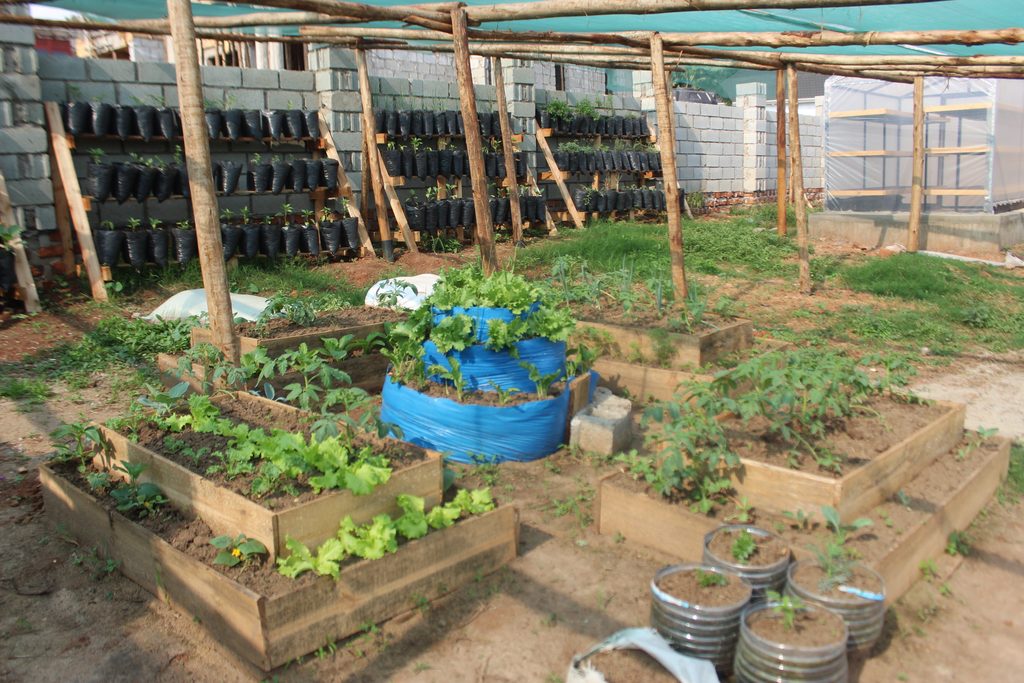
In Wakiso, land is not getting bigger. It is getting divided. A plot that once fed a family is sold, fenced, split between children, or turned into rentals. Houses arrive faster than gardens can move. And yet the same number of people sit down to eat every evening, and the pot still has to be filled.
So the question the women we work with keep asking is not how do I get more land. It is what can I grow in the space I already have.
That question has a better answer than most people expect.
The space is smaller than you think
A kitchen garden does not need a field. It needs a metre or two of ground that gets sun for part of the day, and something to hold soil. In the compounds we visit around Gombe Kitaasa and the surrounding villages, we see gardens growing in places nobody would call a garden: a sack packed with soil and stones down the middle for drainage, with greens coming out of holes cut in the sides. Old basins with a hole knocked in the bottom. A stack of worn tyres. Jerrycans cut lengthwise and lined along a wall. A narrow raised bed built where the wash water runs, so nothing is wasted.
What goes into them is ordinary and deliberate: nakati, doodo, sukuma wiki, spinach, spring onions, tomatoes, eggplant, pepper, and a few sturdy things at the edges; cassava, sweet potato vines, a passion fruit against the fence. Nothing exotic. Nothing that needs a supplier. Most of it can start from seed a neighbour already has.
The point is not that a sack garden replaces a farm. It does not. The point is that it changes what happens between the field and the plate on an ordinary Tuesday, when the money is tight and the market is a walk away.
The plate, not the harvest
We talk a lot in this sector about yield. In a household, the number that matters is much simpler: how many different things are on the plate tonight.
A lot of families eat well in terms of quantity and thinly in terms of variety. Matooke and beans, posho and beans, the same two or three items rotating. The part that goes missing first, when money is short, is the green part — because greens are the thing you buy in small amounts, every few days, in cash. When cash stops, greens stop.
A garden beside the kitchen door takes that item off the shopping list. It is picked at the moment it is cooked, so it does not travel and it does not wilt in a basin at the market. Children who will not sit down to a plate of vegetables will often eat the ones they helped water. That is not a nutrition strategy anyone writes into a logframe, but any mother reading this knows it is true.
A garden that pays twice
Then there is the second harvest, the one that is not eaten.
When a garden does well, it does well all at once. Greens come in faster than one family can finish them, and they do not wait. For the women in the 5 groups we work with under Empowering Women entrepreneurs through business incuabtion, value addition & market readiness support project — Super Women, Dreams, Yesu Asobola, Bakyala Baziira and Biyinziika ; that surplus is not a leftover. It is stock. Bunched and sold at the roadside the same morning. Or dried, and turned into something with a shelf life.
That is where the kitchen garden meets the rest of the programme. At the Business Incubation and Empowerment Centre at Gombe Kitaasa, the drying, grinding, weighing, sealing and labelling equipment that we use for coffee and mushrooms does not care what you feed it. Dried greens can be milled and packed. A product that once had three days of life gets months, a label, a price and a name. And the same certification pathway we are walking with the women through URSB registration and UNBS standards applies to it.
So the sack by the door starts as food. If she wants it to, it becomes a line of stock.
What we are actually doing about it
DRI-Uganda has worked in livelihoods since 2012, and as a community-based organisation before that, from education and health to humanitarian response in places as far as Teso in the east. Everywhere we have worked, the same pattern shows up: the household that eats reliably has more room to take a business risk. Hunger makes people cautious in exactly the way that keeps them poor.
So the kitchen garden is not a side activity for us. Under this project that has been running from November 2025 to September 2026 with the support of Islamic Relief Netherlands it sits alongside the incubation, the value addition and the market-readiness work, because a woman building a business should not be spending her working capital on the evening’s greens.
What that looks like in practice is training the groups on setting up and maintaining small-space gardens, working through the ordinary problems that kill them; the sack that waterlogs because nobody put stones in the middle, the bed that dries out because it was placed where the afternoon sun sits, the seedlings planted too close because it seemed a shame to waste seed; and then connecting the surplus back to the Centre.
If you want to start with one sack
Start with one. Fill it with good soil mixed with well-rotted manure, build a column of stones up the centre so water goes down instead of sitting, cut planting holes in the sides once it settles, and plant one thing you already know how to cook. Water it in the evening. Give it three weeks before you judge it.
Most people who start with one sack end up with four.
Come and see
If you are in or near Wakiso and you want to see the gardens or the Centre, or if you are an organisation interested in working with us on nutrition and livelihoods, we would be glad to hear from you.
Email us at info@dri-uganda.org or call +256 394 822 001. Development and Relief Initiative — Uganda, Gombe Kitaasa, Wakiso.